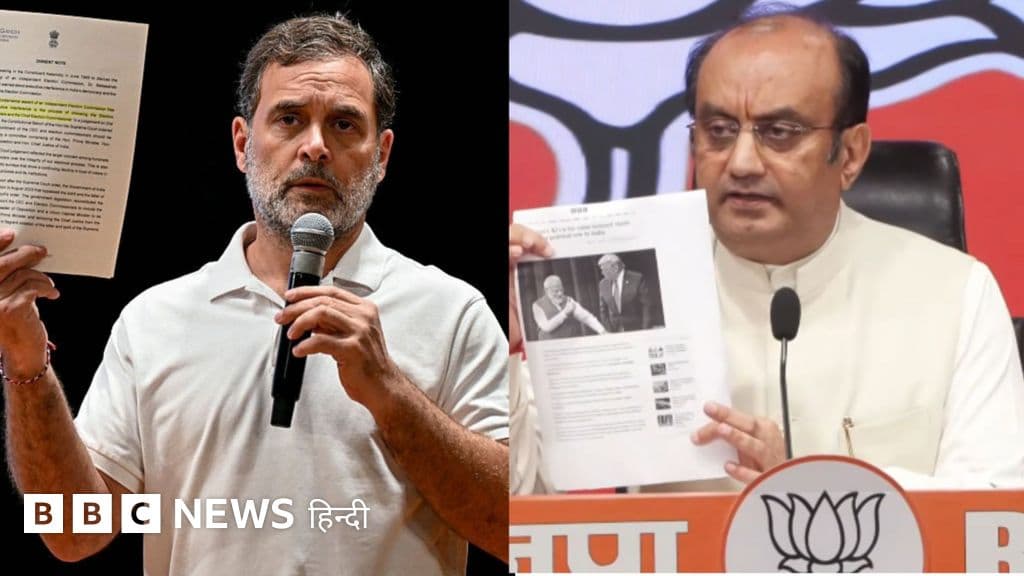
In Indian politics, several issues often gain traction that have little to do with the daily struggles of the common people, remaining limited to ideological debates and dietary preferences. Recently, a major discussion in political circles is that the Bharatiya Janata Party has begun to distance itself from this kind of politics. There is widespread discussion within and outside the party that the saffron party's complete focus should now remain solely on development works and administrative reforms.
This is not the first time in the country's political history that attempts have been made to make food, lifestyle, or personal preferences the center of electoral debate. However, the top leadership of the party has now started realizing that such controversial and unnecessary issues sideline the mainstream development agenda. The common voter wants to talk about basic facilities like inflation, unemployment, roads, water, and education, rather than what is being served on whose plate.
Development vs. Identity Politics: Is the Agenda Changing?
Political analysts believe that the Bharatiya Janata Party has been bringing a major shift in its strategy over the past few years. The party now wants to establish itself as a force that talks about the development of every section of society. Continuous rhetoric on identity politics and food-related issues often leads to polarization, but the middle class and young voters who want employment and progress often feel uncomfortable.
This is the reason why senior party leaders have started exercising restraint in their statements. Leaders have been given clear instructions to avoid statements that have no solid policy basis and are merely made to stay in the media headlines. The public now holds leaders accountable for their work, and politicians are also beginning to realize that elections cannot be won for long solely on emotional issues without solid performance.
Opposition Reaction and Political Gains and Losses
Whenever a ruling party changes its stance on an issue, reactions from the opposition are natural. Opposition parties claim that the BJP has taken this step due to electoral compulsions. The opposition also argues that for a long time, polarizing society was promoted by stoking such issues, and now when the public is asking questions about development, the tune is strategically changing.
According to political experts, every move in politics has its own pros and cons. On one hand, through this approach, the party can further strengthen its pro-development base, while on the other hand, a section of hardcore ideological workers may feel that the party is moving away from its core identity. However, to achieve victory in the electoral arena, every party has to make changes in its strategy with time.
Common Public Expectations and Ground Reality
From the perspective of the common man, it does not matter much which party is playing politics on which issue. A very large section of the country is still searching for its livelihood, children's education, better health services, and employment opportunities. When leaders talk about these basic subjects, the public connection becomes direct and deep.
Recent election results also bear testimony to the fact that voters have now started evaluating on the basis of work instead of casting votes only on slogans and emotional debates. This is the very reason why political parties are being forced to change their working style. BJP's new stance is also considered an attempt to accept this ground reality.
Direction and Future of Politics
The direction in which Indian politics will move in the coming times will depend on how long the parties can maintain these positive changes in their conduct. If leaders maintain development and good governance as their priority not just rhetorically but also at the grassroots level, a healthy change in the country's political culture can be witnessed.
"The real purpose of politics should be to improve the standard of living of the people. When we get entangled in issues that have nothing to do with the ground reality, we deviate from our main goal. Development is the biggest and truest agenda." — Senior Political Analyst
In conclusion, this decision to distance oneself from food and lifestyle politics indicates the maturation of Indian politics. If all parties walk on this path and focus their energy only on public welfare issues, the democratic framework of the country will become stronger and the public's trust in politics will increase further.