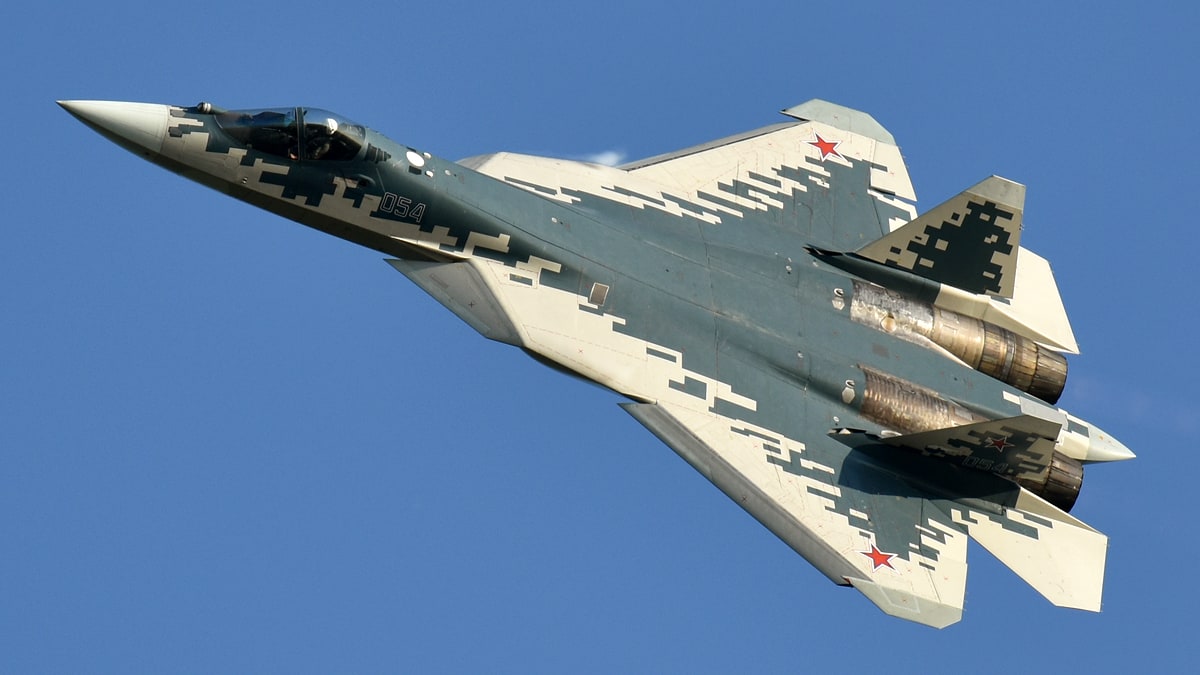
From the corridors of South Block to the Air Force Headquarters in New Delhi, one name is dominating defense discussions—Sukhoi-57 (Su-57). Surging on Google Trends, this topic has triggered intense debates among defense experts and strategists. The Freelance's on-the-ground investigation reveals that Russia has tabled a massive and tempting offer regarding its most advanced fifth-generation stealth fighter jet, the Su-57, to India. However, the strategic, economic, and tactical implications of this deal run deep.
The Russian Offer and Potential 1 Lakh Crore Deal
According to reports and insider hints, Russia is offering to supply approximately 75 Sukhoi-57 fighter jets to India. The estimated cost of this massive deal is pegged at around 1 lakh crore rupees. Coming right ahead of the BRICS summit, this news has sent shockwaves through the defense market. Russia claims that real-world combat experience from the Ukraine conflict has helped upgrade the Su-57's avionics, radar, and stealth capabilities, which it is willing to share with a strategic partner like India.
IAF Chief's Remarks and the Quest for 5th Gen Jets
Recent statements by IAF Chief Air Chief Marshal A.P. Singh have given a new direction to this debate. The Indian Air Force has long been contemplating strengthening its fifth-generation capabilities. Globally, Lockheed Martin's F-35 and Russia's Su-57 are the primary options up for serious consideration. While Western technological controls and geopolitical equations create hurdles for the F-35, Russia's long-standing defense partnership makes the Su-57 technically more accessible for India.
The Chinese Stealth Threat and Strategic Pressure
Along India's northern borders, China is steadily strengthening its fleet of fifth-generation fighter jets, including the J-20. Consequently, the Indian Air Force faces a time crunch. While 4.5-generation aircraft like Rafale and Tejas are exceptional, countering the Chinese stealth threat demands an immediate game-changer. Russia's new move appears to be a calculated strategy to exploit this security compulsion.
Will It Jeopardize Rafale, Tejas, and the AMCA Plan?
This is the most sensitive question in the entire narrative. Defense analysts are pondering whether spending nearly 1 lakh crore rupees on the Su-57 will impact India's domestic defense programs.
- Tejas (Tejas Mk1A/Mk2): The light combat aircraft fleet is progressing, though production delays remain a challenge.
- AMCA (Advanced Medium Combat Aircraft): India's ambitious indigenous fifth-generation stealth fighter project. If heavy capital is diverted to buy the Su-57, will it starve the AMCA R&D fund?
- Rafale: Additional squadrons for the Navy and Air Force are already in the pipeline, and the Su-57's entry could complicate these equations.
Conclusion: A Calculated Move for India
The Freelance's investigation concludes that while Russia's Su-57 offer provides a shortcut to acquire 5th-generation combat capability overnight, it also poses a major test for the indigenous AMCA program under 'Atmanirbhar Bharat'. In the coming months, the Defense Acquisition Council (DAC) and political leadership must decide whether to prioritize immediate operational readiness or long-term strategic self-reliance.