
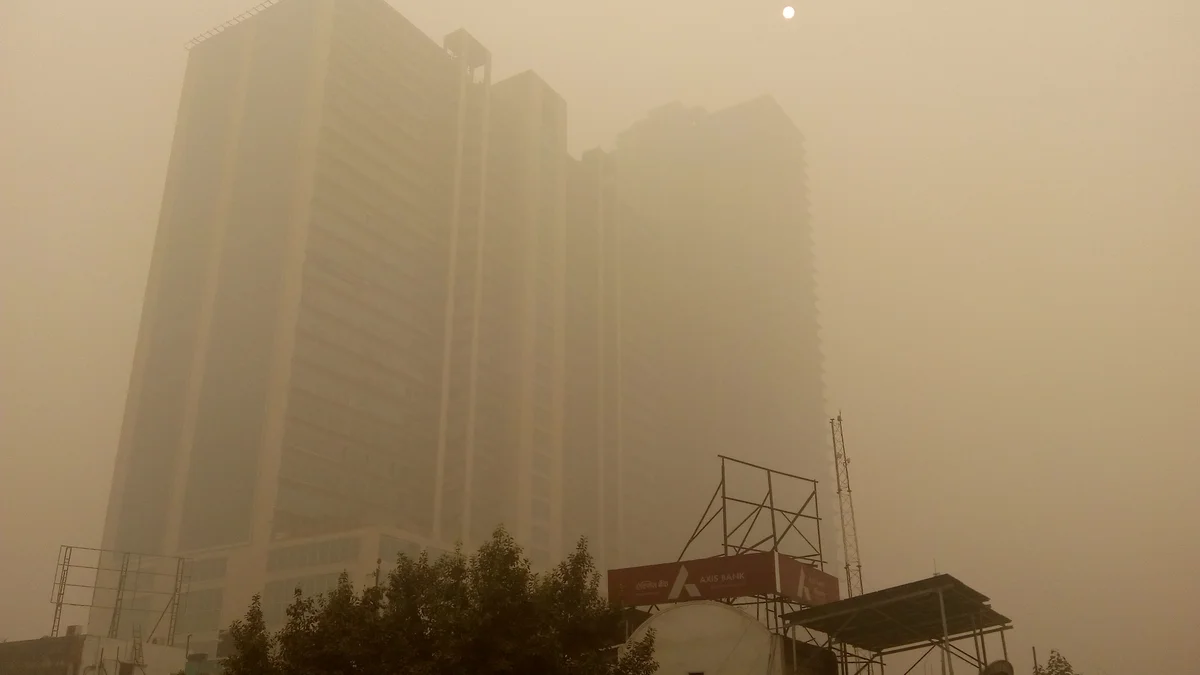
With the withdrawal of the monsoon from the national capital, Delhi's air quality has taken a severe hit. The first week of October has turned out to be the most polluted in the last three years, with the average Air Quality Index (AQI) touching 171, raising serious environmental and health concerns.

Steady Decline in Air Quality
The city's air quality started on October 1st at an AQI of 166, which gradually rose to 174 by October 2nd. The situation peaked on October 4th when the AQI touched 187, making it the worst day of the week. Although there was a slight dip later, the weekly average remained high at 171, signaling an alarming start to the winter pollution season.
Comparing past trends, the average AQI for the first seven days of October stood at 112 in 2021, 141 in 2022, 176 in 2023, 155 in 2024, and 117 in 2025. This year's average of 171 marks it as the second-highest start in six years, trailing only behind 2023.
Stagnant Winds and Stubborn Weather
According to the Central Pollution Control Board, an AQI between 101 and 200 falls under the 'moderate' category. However, meteorological conditions like low wind speeds—averaging below 10 kilometers per hour—are trapping pollutants close to the surface, preventing effective dispersion.

Adding to the woes, residents are also grappling with unseasonal warmth. Safdarjung recorded a maximum temperature of 35.7 degrees Celsius, which is 1.5 degrees above normal, while minimum temperatures hovered around 25 degrees. Authorities warn that unless wind patterns change drastically, air quality is likely to remain in the moderate to poor bracket in the coming days.
'The Freelance' does not independently verify the claims of viral videos or user-generated reports on social media. Video Courtesy: Respective Social Media Handles / Creators.





States & Regional Bureau, The Freelance
Verified Editorial DeskState Affairs & Grassroots Reporting Bureau
Delivering verified, on-the-ground reporting on state governance, regional development, grassroots public challenges, and local administrative reforms across India. We are committed to unbiased, factual journalism based on verified agencies, official statements, and on-the-ground correspondents.