
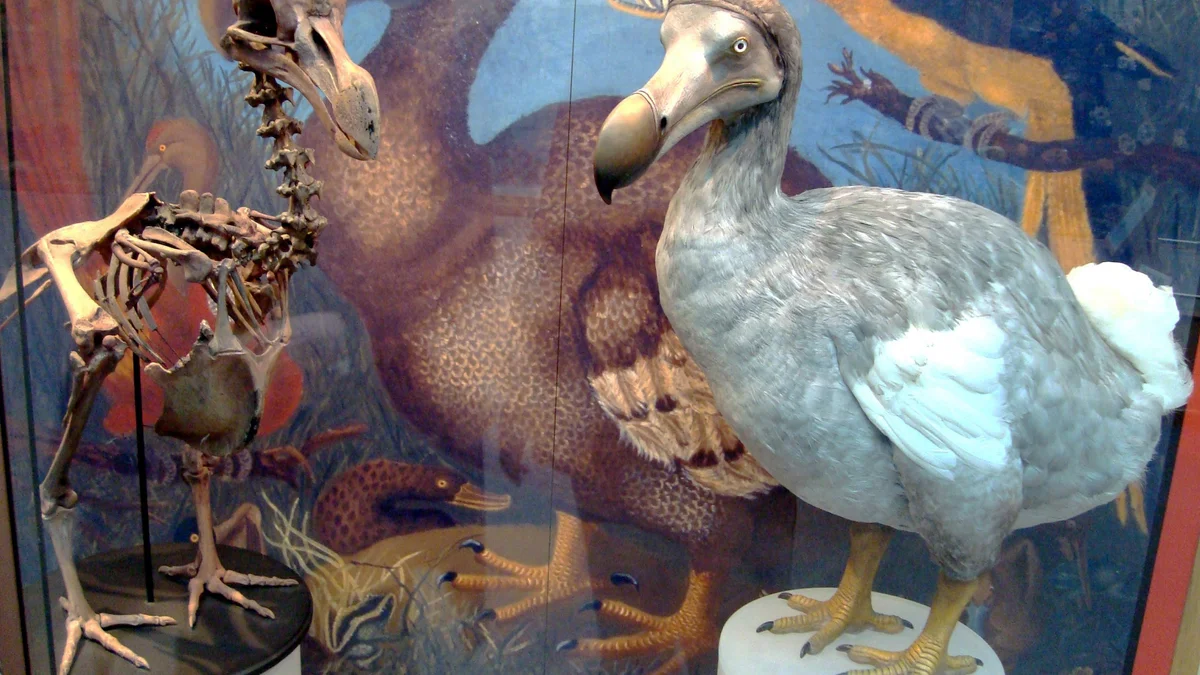
Approximately 360 years ago, the Dodo bird, driven to extinction by humans, is now the subject of an ambitious scientific endeavor to bring it back to Earth. This mission represents a hope to rectify past mistakes and restore biodiversity. American biotech company Colossal Biosciences has announced significant progress in this direction, using Artificial Intelligence (AI) to identify crucial genes in Dodo DNA responsible for its unique beak and facial structure. This discovery has injected new energy into the prospects of Dodo de-extinction, though it remains an incredibly complex and long process.

The Dodo's Tragic Tale and the Hope for Revival
The Dodo (Raphus cucullatus) was a flightless bird native to the island of Mauritius in the Indian Ocean. About the size of a turkey, with a large beak and small wings, it was incapable of flight. When European sailors arrived in Mauritius in the 17th century, they began hunting the Dodo. Concurrently, invasive animals like rats, pigs, and monkeys, brought by the sailors, preyed on Dodo eggs and chicks. These factors led to a rapid decline in the Dodo population, culminating in its complete extinction by 1662, with the last recorded sighting of a living Dodo. The Dodo's extinction is often cited as a tragic example of anthropogenic destruction.
Now, Colossal Biosciences has undertaken the task of bringing the Dodo back under a revolutionary concept called 'De-Extinction'. The company aims to revive extinct species through scientific methods, including projects for the Woolly Mammoth and Thylacine. In the case of the Dodo, scientists are attempting to introduce Dodo-like traits by modifying the genes of its closest living relative, the Nicobar Pigeon. This endeavor is more than just bringing back a single species; it could be a significant step towards balancing ecosystems and conserving biodiversity.
AI and Genes: Unlocking the Dodo's Extinct Secrets
Understanding the Dodo's DNA has been a major challenge. The DNA of extinct organisms fragments over time, making it difficult to pinpoint which genes were responsible for specific physical characteristics. To overcome this, Colossal Biosciences has developed an advanced AI platform called 'Genomorph'. This AI platform analyzes detailed 3D structures of beaks and skulls from over 70 living bird species and correlates these structures with their genetic data.

Using this extensive dataset, the Genomorph AI has identified approximately 2300 potential genes linked to the Dodo's large beak and distinct facial features. These genes are now undergoing intensive laboratory investigation to confirm their precise role in shaping the Dodo's unique identity. This AI-driven approach is helping scientists unravel the complex genetic mysteries of extinct species that once seemed impossible to decipher. The Nicobar Pigeon, found on some islands in Southeast Asia and known for its vibrant plumage, is a crucial link in this project because its DNA closely resembles that of the Dodo. The company has increased its Nicobar Pigeon population to 36 in Texas, where their development, reproduction, and genes are being studied.
The Dodo's Return: Challenges and Ethical Debates
Creating a bird with Dodo-like characteristics is a scientifically intricate task. First, scientists must prove that the genetic modifications indeed produce the desired physical traits. Furthermore, it must be ensured that these genetic changes are successfully passed on to subsequent generations without negatively impacting reproductive viability. Creating a Dodo-like bird in a laboratory is one thing; creating a species that can survive and thrive in its natural environment is an entirely different challenge. Colossal Biosciences has not yet specified when the first Dodo-like bird might be born, but the process is expected to span decades.
Moreover, if such birds are to be reintroduced to Mauritius in the future, a safe and suitable habitat must be prepared for them. This means controlling invasive animals (like rats and pigs) that contributed to the Dodo's original extinction, and restoring the Dodo's former habitat to its pristine state. This ecological restoration will require extensive research, conservation efforts, and the cooperation of local communities. Ethical debates also continue regarding the Dodo's revival: Should we 'play God' with nature? Should these resources not be used to save currently endangered species? However, Colossal Biosciences is working with Mauritian scientists, environmental organizations, and the government to address these challenges. For now, the effort to bring back the Dodo is in its early stages, and only after further investigation of the AI-derived clues will it become clear how far scientists can advance in this direction.
'The Freelance' does not independently verify the claims made in this viral social media video. This video has become a widely discussed topic on social media. Video Credits: Respective social media handle / Creator.




Tech & Auto Desk, The Freelance
Verified Editorial DeskTechnology, AI, Cybersecurity & Mobility Bureau
Providing objective product reviews, cybersecurity alerts, artificial intelligence breakthroughs, and automotive industry developments for smart consumers. We are committed to unbiased, factual journalism based on verified agencies, official statements, and on-the-ground correspondents.